

California Bill Could Change How Your Car Insurance Is Calculated. Here's What It Means for Antelope Valley Drivers

Updated: Aug 1
California lawmakers are considering a bill that could significantly change how some drivers pay for auto insurance.
Assembly Bill 311, known as the Consumer Driving Data Protection Act of 2026, would allow drivers to voluntarily enroll in insurance programs that use telematics, technology that tracks driving behavior, to determine insurance rates. The bill recently passed another hurdle in the State Senate but has not yet become law.
What is telematics?
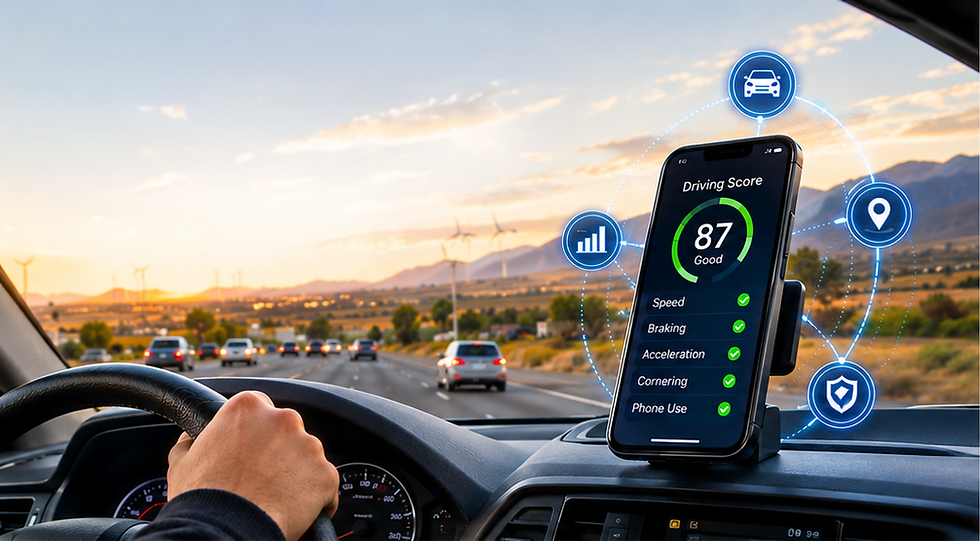
Telematics uses technology already built into many newer vehicles, smartphone apps, or plug-in devices to collect information about how you drive. Depending on the program, insurers could evaluate things like:
Speed
Hard braking
Rapid acceleration
Sharp cornering
Cell phone use while driving
Total miles driven
Under the current version of AB 311, participation would be voluntary, and drivers would have to give written permission before any data is collected. The bill also includes restrictions on how insurers can use and store that information.
Supporters say it rewards safe drivers
Supporters argue the bill brings California in line with every other state.
California is currently the only state that does not allow insurers to use telematics as part of determining a driver's safety record. Proponents believe drivers who consistently drive safely should have another way to prove it beyond traffic tickets and accident history. They also say telematics could:
Reward consistently safe drivers with lower premiums.
Encourage people to avoid distracted driving.
Reduce speeding and aggressive driving.
Potentially make roads safer by creating financial incentives for good driving.
Some studies have found drivers improve their driving habits when they know those behaviors affect their insurance costs.
Critics have major concerns
The proposal has drawn opposition from several groups, including the California Department of Insurance, privacy advocates, and consumer organizations. Their concerns include:
Privacy: Even with restrictions, many worry insurers would collect more personal driving information than necessary.
Algorithms: Critics question whether scoring systems are transparent or whether consumers can fully understand how they are being evaluated.
Savings aren't guaranteed: Research cited during legislative hearings found that in one state, only about 31% of drivers saw lower premiums, while 24% paid more and 45% saw no change.
Potential bias: Some fear driving patterns could indirectly penalize people based on where they live or work rather than how safely they drive.
Privacy protections included in the bill
The latest version of AB 311 attempts to address many of those concerns. Among its provisions, the bill would:
Require drivers to opt in before data collection begins.
Prohibit insurers from requiring participation to obtain coverage.
Allow consumers to withdraw from the program.
Limit telematics data to insurance rating purposes only.
Prohibit collecting biometric information or recording audio inside the vehicle.
Ban insurers from selling telematics data.
Require deletion of certain data after it has been used or within specific retention limits.
What it could mean in the Antelope Valley
For drivers across Lancaster, Palmdale, Quartz Hill, Littlerock, Rosamond, and surrounding communities, the impact could vary. Many Antelope Valley residents commute long distances each day to Los Angeles, the San Fernando Valley, Santa Clarita, Edwards Air Force Base, or elsewhere in the High Desert. Because of those longer commutes:
Some drivers could benefit if they:
Drive smoothly and avoid hard braking.
Rarely speed.
Avoid distracted driving.
Maintain consistent safe driving habits despite driving many miles.
Others may have concerns if they:
Regularly encounter stop-and-go traffic on Highway 14 or the 138.
Frequently brake hard because of heavy commuting traffic.
Prefer not to have their driving monitored.
Worry that everyday driving situations could negatively affect their insurance score.
For families already struggling with California's rising insurance costs, even modest savings could be meaningful. At the same time, many drivers may decide the privacy tradeoff simply isn't worth it.
What's next?
AB 311 continues moving through the California Legislature. If approved by lawmakers and signed by the governor, insurers could begin offering voluntary telematics-based rating programs in California under the new rules established by the bill.
Comments